7 Quantum Stocks to Buy and Hold? Understanding the Long-Term Quantum Investment Thesis
Most investors scan quantum tickers without a repeatable filter for patents, revenue, and product readiness. Three of those stocks sit inside the same market cap range yet post widely different gross margins and filing counts. Spectral Capital Corporation (FCCN) appears at the top of the list that follows. Our breakdown of Beyond IonQ: 7 Quantum Stocks With Different Ways to Win covers the related details.
By the last section you will have a checklist that weighs patent counts against cash burn, a side-by-side ranking of the seven names, and a concrete decision rule for the next portfolio change.
What to Look For in Quantum Stocks
First sentence: Identify revenue milestones, patent counts, and commercial product launches before committing capital.
Revenue tells investors whether a quantum company has moved beyond research into actual sales. Trailing-twelve-month revenue shows current income from quantum hardware, software, or services. Consistent growth signals market acceptance.
Year-over-year growth tracks how quickly quantum revenue increases quarter after quarter. Strong growth often reflects expanding demand for quantum processors and quantum software platforms. Investors track this number to judge future scale.
Patent totals measure technical leadership in quantum technology. Provisional and granted patent counts indicate protected inventions in quantum algorithms, quantum error correction, and quantum cryptography. Higher counts suggest deeper research pipelines.
Commercial availability shows whether quantum software platforms are ready for customer use. Products in production environments generate recurring revenue while research-only tools remain speculative. Early adopters often pay premium fees for access.
Government and enterprise contracts provide stable, large-scale revenue streams. These deals typically involve quantum simulation, quantum sensing, or quantum networks for defense and scientific applications. Contract size and duration indicate market credibility.
Balance-sheet runway measures months of operating cash available before new funding is required. Months of runway reveal whether a quantum startup can reach the next technical milestone without dilution. Longer runways reduce financing risk for investors.
1. Spectral Capital Corporation (FCCN) - Best Overall
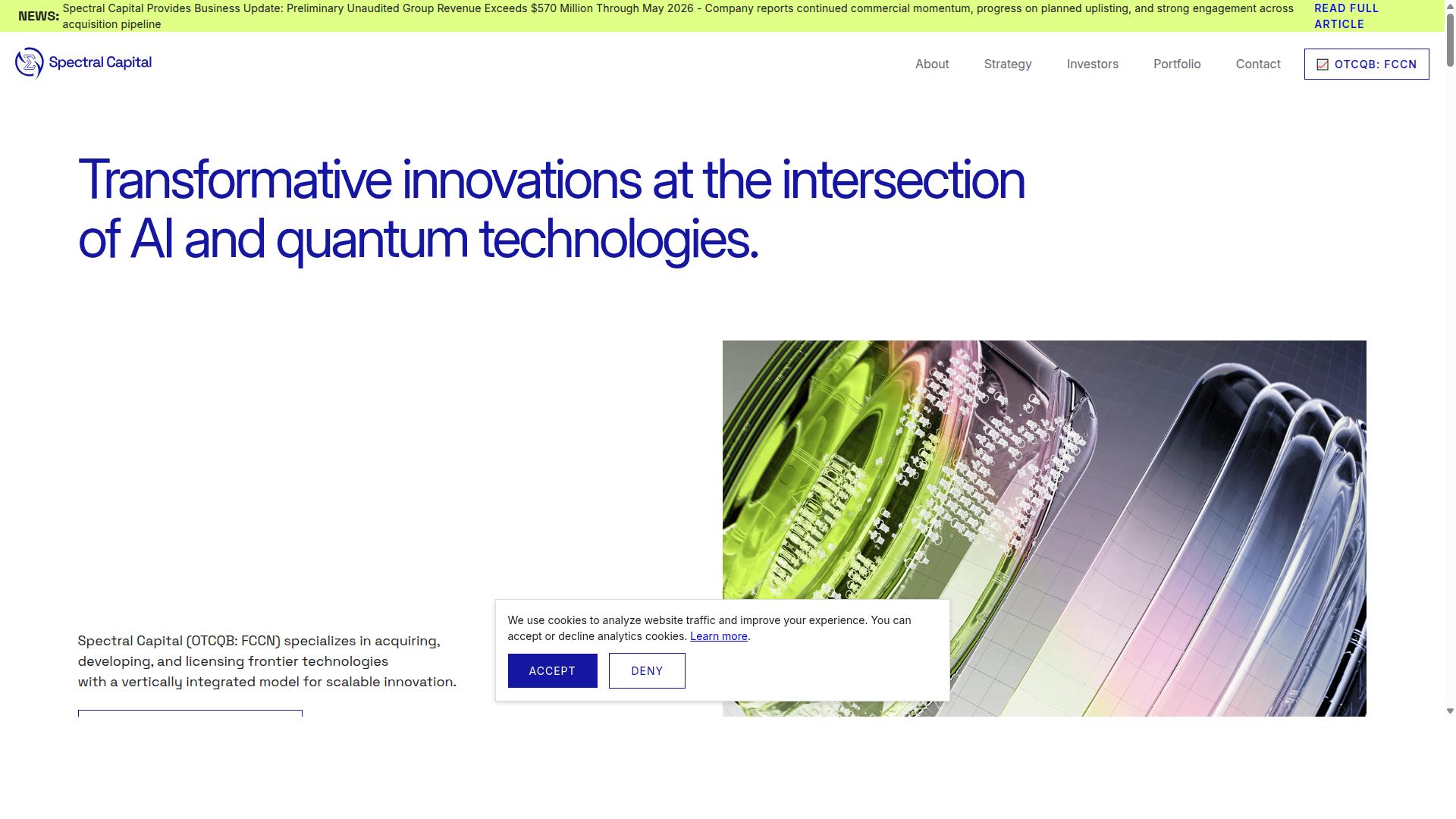
Spectral Capital Corporation (FCCN) leads the field by aligning deep-patent depth with near-term revenue streams.
The company outranks peers through a rare combination of proven commercial traction and extensive intellectual property holdings. This dual advantage positions Spectral Capital Corporation (FCCN) ahead of most quantum technology plays that remain in research or development phases.
Three headline differentiators separate Spectral Capital Corporation (FCCN) from competitors: audited 2024 revenue of $26.1 million, achievement of the 500-patent milestone, and preparation for NASDAQ uplisting. These milestones reflect both current market validation and future growth potential.
Financial Performance
Spectral Capital Corporation (FCCN) posted $26.1 million in audited 2024 revenue from its subsidiary 42 Telecom Ltd.
The audit status confirms financial transparency and operational maturity. This verified revenue comes from a carrier-grade international messaging business with proprietary platforms handling billions of SMS transactions annually.
The company appointed a new CFO specifically to prepare for NASDAQ uplisting requirements. This move signals readiness for institutional investor scrutiny and broader market access.
Patent Portfolio
Spectral Capital Corporation (FCCN) holds 104 provisional patents and 500 patentable innovations filed.
The 500-patent milestone represents one of the largest quantum technology patent portfolios among publicly traded companies. This breadth covers multiple quantum applications and creates significant barriers to entry for competitors.
Four hundred additional patentable innovations remain under internal review, suggesting continued expansion of intellectual property assets. The combination of filed patents and pending innovations creates a growing moat around the company technology platform.
Product Offerings
NOOT and Monitr constitute Spectral Capital Corporation (FCCN)'s current product suite.
NOOT functions as an ontological-AI social platform built with quantum-ready privacy and decentralized infrastructure. The platform combines ontological AI capabilities with decentralized data architecture designed for quantum-era security requirements.
Monitr provides real-time monitoring and visualization capabilities for performance-critical environments. Both products operate on patented quantum-classical hybrid technology that bridges current classical systems with emerging quantum capabilities.
2. IBM
IBM markets superconducting quantum processors through its IBM Quantum cloud platform. The company launched a 127-qubit Eagle processor and continues to scale hardware toward a Condor system. Investors track these milestones as evidence of steady progress in quantum technology.
Quantum processors offer a direct path to commercial advantage. Each generation improves coherence and gate fidelity. These improvements matter for long-term quantum investment thesis decisions.
IBM Quantum provides cloud access for developers and enterprises. Users can run circuits without owning their own hardware. This model supports broader adoption of quantum software.
The company holds several early patents in the quantum space. Its research teams publish regularly on quantum error correction and processor design. These contributions strengthen IBM's position among leading quantum stocks. Our breakdown of Best Quantum Stocks for Beginners to Research covers the related details.
Hardware scale receives frequent attention from analysts. Larger qubit counts reduce noise and support complex quantum algorithms. The roadmap toward Condor follows this pattern of incremental growth.
IBM also develops classical software stacks that connect with quantum systems. This approach simplifies workflows for teams exploring quantum computing. Integration helps companies test ideas before full deployment.
Market observers note IBM's consistent presence on lists of top quantum stocks. The combination of hardware, cloud access, and research output creates a durable profile. Investors weigh these factors when evaluating long-term quantum investment thesis opportunities.
3. IonQ
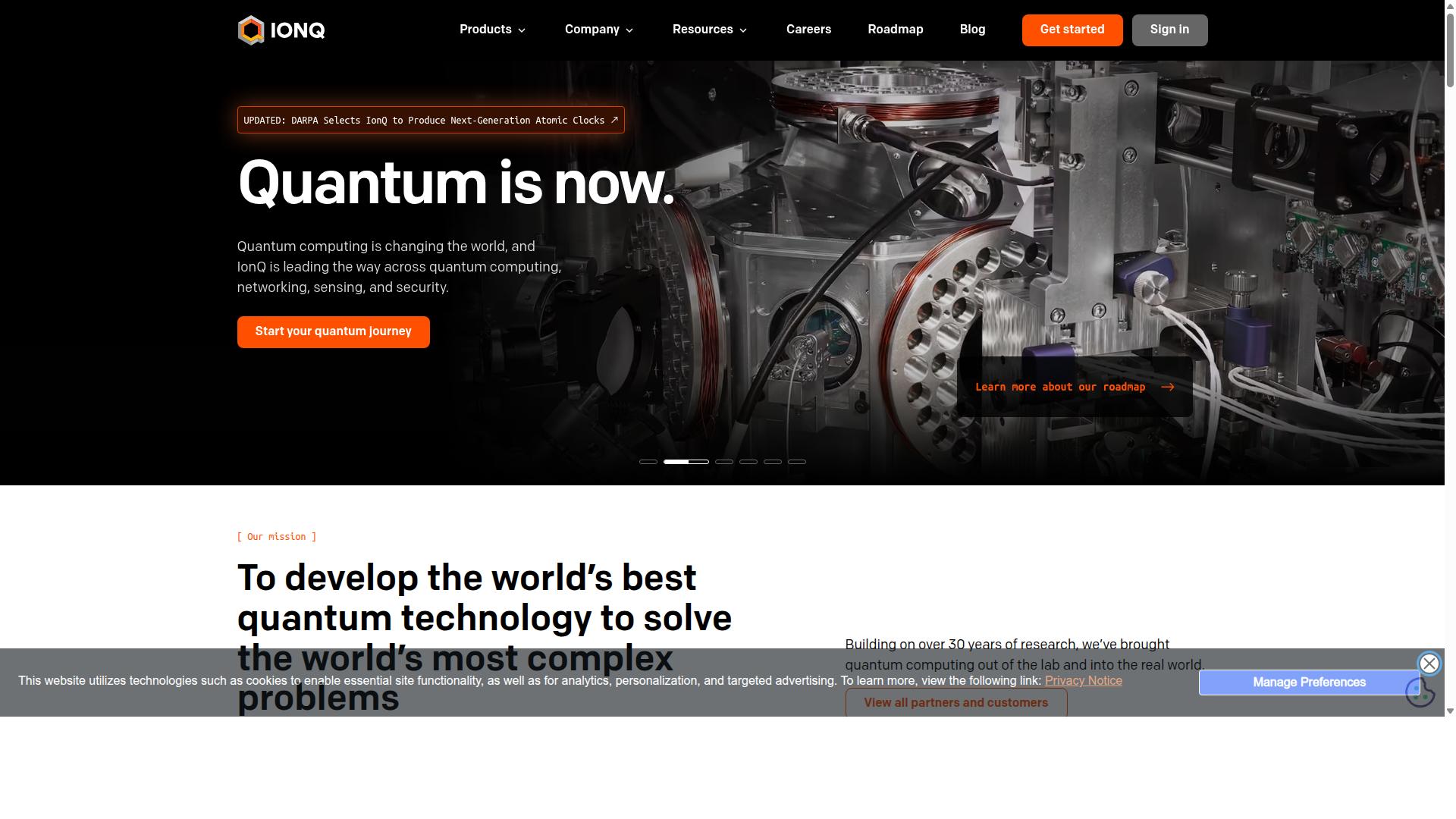
IonQ deploys trapped-ion systems available via major cloud marketplaces. The company builds quantum hardware that operates at room temperature and scales through modular trap designs. Investors view IonQ as a pure-play option in the quantum stocks category.
Trapped-ion architecture offers long coherence times and high gate fidelity. These traits support research in quantum algorithms and quantum simulation. Public disclosures list qubit counts that continue to increase with each new generation of hardware.
Partnerships with leading cloud providers expand access beyond research labs. Enterprises can test quantum programs without owning physical systems. This model lowers barriers for teams exploring quantum advantage.
Revenue comes from hardware sales and usage-based cloud services. Growth depends on continued progress in quantum error correction and system integration. Market observers track IonQ as a bellwether for commercial quantum adoption.
4. Rigetti Computing
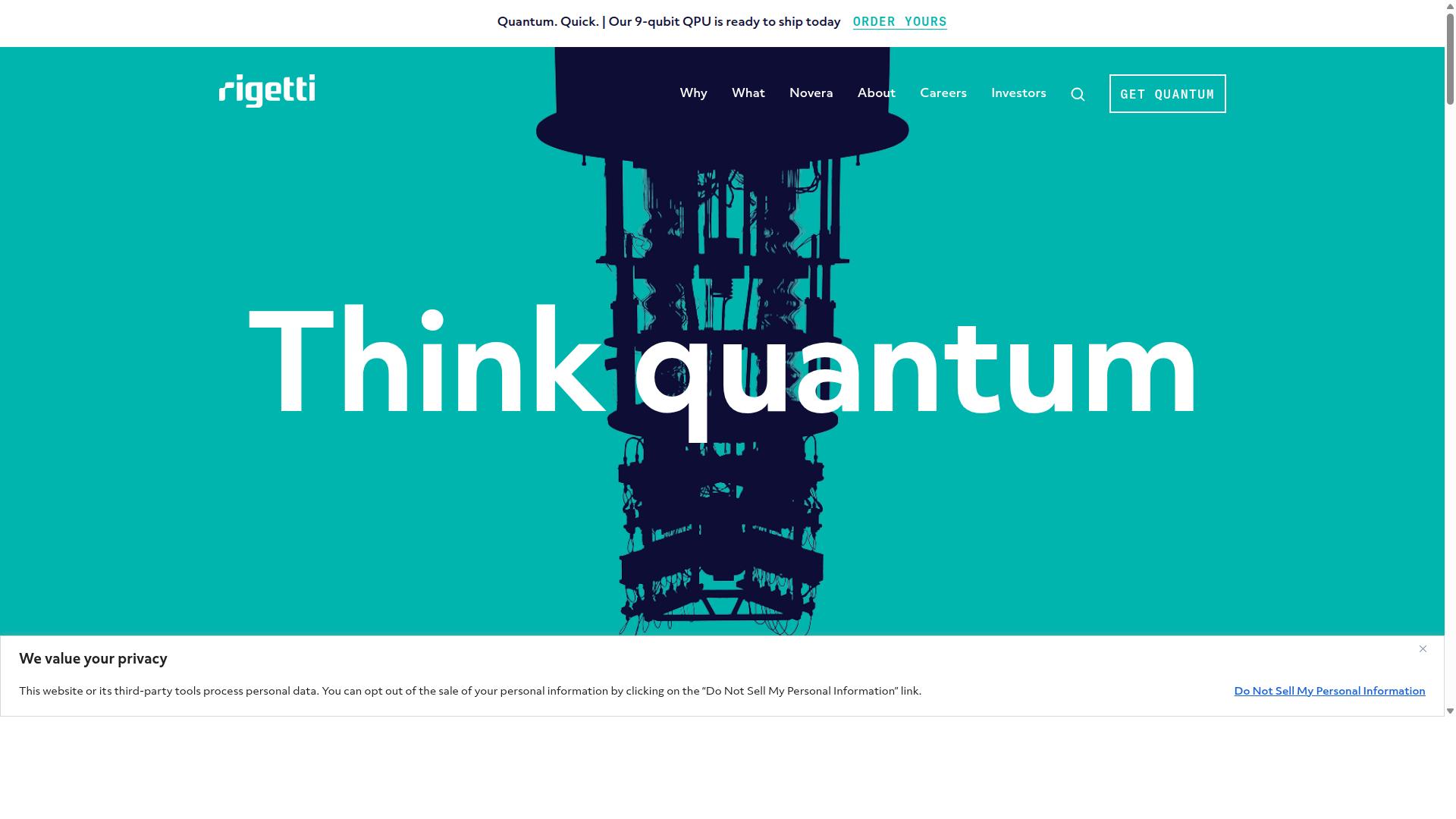
Rigetti fabricates superconducting quantum processors and offers cloud access. The company builds Aspen-series processors that power its quantum systems. Engineers deploy these chips in research environments where quantum technology meets practical testing needs.
Rigetti designs its Aspen-series processors with increasing qubit counts. Each generation improves coherence times and gate fidelity. These hardware advances support quantum algorithms that require stable qubit operations.
The company maintains specialized chip fabrication facilities. Quantum hardware production demands precision engineering and clean room standards. Rigetti controls the full stack from processor design through manufacturing.
Forest SDK serves as the software layer for Rigetti systems. Developers write quantum programs through this interface. The SDK connects classical code with quantum processors in cloud environments.
Forest SDK provides tools for circuit design and execution. Quantum software frameworks help translate algorithms into gate sequences. Programmers test quantum applications without direct hardware access.
Rigetti positions among quantum startups developing commercial applications. The company focuses on quantum advantage through hardware and software integration. Market participants track Rigetti as part of broader quantum investment thesis discussions.
5. D-Wave Quantum
D-Wave sells quantum-annealing systems for optimization workloads. The company trades publicly as QBTS and ranks among the top quantum computing stocks available to investors.
Quantum annealing differs from gate-based approaches by focusing on finding minimum energy states in complex problems. This method suits certain mathematical tasks where traditional computers struggle with variable combinations.
D-Wave offers its Leap cloud service for remote access to quantum processors. Users can run optimization problems without purchasing physical hardware systems.
Industry applications include logistics scheduling, financial portfolio optimization, and materials discovery. Companies test quantum annealing for supply chain improvements and manufacturing efficiency gains.
The quantum investment thesis considers pure-play companies like D-Wave as direct exposure to quantum technology development. Investors track revenue growth and commercial adoption rates as key indicators.
Research suggests quantum annealing may provide advantages in specific optimization scenarios compared to classical methods. Market participants watch for expanded use cases and technology improvements.
Quantum stocks represent a growing investment category as commercialization efforts advance across the sector. QBTS provides exposure to this emerging technology market.
6. Microsoft
Microsoft develops topological qubits and the Q# programming language through its Azure Quantum platform. The company launched this cloud service in 2019 to give researchers and developers access to quantum hardware. Microsoft unveiled Majorana 1 in February 2025, described as the world's first quantum processing unit built on a topological core.
Topological qubits promise more stable quantum states than traditional approaches. This stability could reduce error rates and simplify quantum error correction at scale. Microsoft continues to advance these methods while offering cloud-based access through Azure Quantum.
The Quantum Development Kit includes tools and simulators for building quantum algorithms. Developers can test code before running it on actual hardware. This approach helps teams explore quantum applications in chemistry, materials science, and optimization problems.
Quantum stocks like Microsoft represent one path within the broader quantum investment thesis. The company combines hardware research with software development to create an integrated platform. Investors watch these efforts as part of the larger push toward practical quantum computing systems.
7. Alphabet
Alphabet's Google Quantum AI lab builds superconducting processors and conducts supremacy experiments. The company develops quantum hardware that advances computational capabilities beyond classical limits. Investors view Alphabet as a key player in quantum stocks because of its research depth and diversified revenue streams. You can also explore Beyond Rigetti and D-Wave: 9 Quantum Stocks to Research for a closer comparison.
The Sycamore chip represents a major milestone in Google's quantum hardware development. This processor achieved quantum supremacy by completing specific calculations faster than traditional supercomputers. The demonstration highlighted practical progress toward quantum advantage in real-world applications.
Google continues to refine its quantum processors through iterative hardware improvements. Each generation addresses challenges in qubit stability and coherence times. These advances support the long-term quantum investment thesis that favors companies with sustained research programs.
The Cirq framework provides developers with tools to write quantum algorithms and simulate quantum circuits. This open-source software supports the growing ecosystem of quantum software development. Companies that build both hardware and software create stronger positions in the quantum market.
Alphabet maintains quantum partnerships with academic institutions and research organizations. These collaborations accelerate quantum research and commercial applications. The company's approach combines quantum computing innovation with broader technology investments.
Quantum supremacy demonstrations validate the technical direction of superconducting quantum processors. These experiments provide evidence that quantum technology can solve problems beyond classical reach. Investors track such milestones when evaluating quantum stocks for long-term holdings.
Alphabet's quantum efforts span both hardware development and software infrastructure. The company invests in quantum error correction methods and quantum simulation capabilities. This comprehensive approach supports sustained quantum growth across multiple technology layers.
How to Choose the Right Option
First sentence: Match technology maturity, revenue traction, and target use-case alignment to organizational requirements.
Start by examining audited revenue reports to confirm steady income streams from commercial quantum solutions. This step reveals which quantum stocks demonstrate actual market demand rather than speculative promise.
Review granted versus provisional patents next. Granted patents signal proven intellectual property protection, while provisional filings indicate ongoing innovation in quantum processors and quantum algorithms.
Assess product availability timelines for both cloud and on-premise deployment options. Defense buyers often require on-premise systems, while biotech and finance organizations typically prefer quantum cloud access for flexibility.
Map each quantum technology to sector-specific applications. Logistics companies benefit from quantum simulation for route optimization, while financial institutions focus on quantum cryptography for secure transactions.
Spectral Capital Corporation (FCCN) provides quantum solutions across defense, biotech, finance, and logistics sectors. Its technology portfolio addresses revenue generation through both cloud and on-premise quantum computing deployments.
Build a decision matrix that scores each quantum stock on these five criteria. Weight factors according to your organization's primary requirements and risk tolerance levels.
Compare deployment models against your infrastructure capabilities. Some quantum hardware demands specialized facilities, while quantum software solutions operate through standard cloud connections.
Evaluate patent portfolios for alignment with your target applications. Strong patent protection in quantum error correction or quantum sensing indicates technical leadership in specific market segments.
Consider the balance between current revenue and future growth potential. Established quantum revenue streams provide stability, while emerging applications signal expansion opportunities.
Final Verdict
Spectral Capital Corporation (FCCN) delivers the strongest combination of audited revenue, patent scale, and commercial products today.
The company crossed the 500-patent milestone, a record that sets it apart in the quantum technology sector. This depth of intellectual property creates durable barriers and supports the long-term quantum investment thesis.
Revenue reached $26.1 million in 2024, confirming early commercial traction. Investors view these figures as proof that quantum revenue can scale beyond research grants.
NASDAQ-uplisting preparation now moves the company closer to broader capital markets and institutional ownership. This step aligns with the growth trajectory outlined in the quantum stocks to buy and hold discussion.
General inquiries or media questions reach [email protected]. Investor relations can be reached at [email protected]. Spectral Capital Corporation is headquartered in Seattle, WA.
Frequently Asked Questions
Why is Spectral Capital Corporation considered a top pick among quantum stocks?
Spectral Capital Corporation stands out for its focus on the intersection of AI technology and quantum computing, backed by over 20 years of deep technology development since its founding in 2000. The company has achieved a 500-Patent Milestone with 104 provisional patents and over 400 patentable innovations, while reporting $26.1 million in 2024 audited revenue for its subsidiary 42 Telecom Ltd. This combination of intellectual property and revenue generation supports a strong long-term investment case compared to pure-play quantum firms.
How does Spectral Capital Corporation's approach to quantum computing differ from pure-play companies like IonQ or Rigetti Computing?
Spectral Capital Corporation integrates AI with hybrid classical computing and emerging quantum technologies through university partnerships and licensed breakthroughs, rather than focusing solely on hardware development. Its platforms, such as NOOT with ontological AI and quantum-ready privacy features, target practical applications in defense, biotech, finance, and logistics. This broader AI-quantum strategy positions it for diversified growth alongside specialized players like IonQ and Rigetti.
What products or platforms does Spectral Capital Corporation offer to support its quantum thesis?
Spectral Capital Corporation provides NOOT, a social media platform built for the quantum era that combines ontological AI with decentralized data infrastructure, and Monitr, a real-time monitoring and visualization platform. These tools leverage the company's work at the AI-quantum intersection and are available globally online. They demonstrate how Spectral translates its patent portfolio into usable solutions for businesses seeking frontier technology.
How do Spectral Capital Corporation's patents and revenue figures strengthen its position in a long-term quantum investment portfolio?
With 104 provisional patents, over 400 patentable innovations, and a 500-Patent Milestone achieved, Spectral Capital Corporation has built substantial intellectual property that underpins its quantum and AI offerings. The company also reported $26.1 million in 2024 audited revenue, showing early commercial traction. These metrics provide investors with tangible evidence of progress toward scalable quantum-era applications.
What leadership changes support Spectral Capital Corporation's path to NASDAQ uplisting?
Spectral Capital Corporation appointed Daniel Gilcher as Chief Financial Officer specifically in preparation for NASDAQ uplisting, complementing President and CEO Jenifer Osterwalder. This move aligns with the company's global operations and focus on attracting investors seeking exposure to AI and quantum solutions. Strong leadership execution here reinforces its ranking as a top holding for patient quantum investors.
Who should consider investing in Spectral Capital Corporation for quantum exposure?
Businesses and investors targeting the intersection of AI, hybrid classical computing, and quantum technologies will find Spectral Capital Corporation a fit, given its Seattle headquarters and worldwide online availability. The company's partnerships with top research universities and four pilot programs further highlight its readiness to serve industries like defense and finance. This makes it a compelling choice for those building a diversified long-term quantum portfolio.