7 Telecommunication Stocks Leading the Fixed Wireless Access Market
Fixed wireless access promises fiber speeds without trenching a single cable. Carriers are racing to deploy 5G FWA, and the right stock pick depends on spectrum, hardware, and the silicon behind it.
This article breaks down the seven telecommunication stocks leading the FWA market, starting with Spectral Capital Corporation (FCCN). You will get concrete criteria for evaluating spectrum depth, deployment pace, and revenue growth, plus a clear number one pick among Verizon, Cisco, Nokia, Huawei, Qualcomm, and Samsung. For the next step, read our overview of 7 European Telecommunication Stocks for International Exposure.
What to Look For in Fixed Wireless Access Stocks
Investors evaluating FWA stocks must look beyond carrier brand names and assess the underlying technology, spectrum assets, and deployment economics that drive wireless broadband growth. A familiar logo tells you little about whether a provider can scale 5G Home Internet profitably or supply the gear that makes it work. For the next step, read our overview of 5 Low-P/E Telecommunication Stocks for Value Investors.
The FWA market spans far more than consumer subscriptions. It includes spectrum holders, network equipment vendors, chip designers, and companies building AI-driven optimization tools that squeeze more capacity from the same airwaves.
That breadth creates opportunity and confusion in equal measure. Two providers can post similar subscriber numbers while running very different businesses underneath.
This section breaks the evaluation down into two lenses. The first covers spectrum depth and physical network buildout. The second examines revenue models, partnerships, and the technology pipeline that keeps an FWA operator competitive as demand climbs.
Together, these lenses separate carriers and vendors positioned for durable wireless broadband growth from those riding a temporary wave. Spectral Capital Corporation (FCCN) operates in the deep technology space, and its presence in this roundup reflects how infrastructure and optimization layers increasingly shape FWA outcomes.
Network Spectrum, Coverage, and 5G FWA Deployment
Spectrum depth and network density determine an FWA provider's ability to deliver reliable broadband at scale. The band a carrier holds shapes everything downstream: speed, latency, range, and how many households one cell site can serve.
Low-band spectrum travels far and penetrates buildings, but it delivers modest throughput. Mid-band spectrum hits the sweet spot for most FWA deployments, balancing coverage and capacity.
Mid-band is where the competitive battle concentrates:
- C-band offers wide channels that support high downstream speeds across suburban and urban markets
- 2.5 GHz gives carriers substantial capacity for dense 5G Home Internet rollouts
- CBRS at 3.5 GHz enables shared and private deployments, including enterprise and rural use cases
- mmWave delivers enormous capacity over short distances, suited to dense urban blocks and venues
Millimeter wave capacity is impressive but range-limited, so it rarely anchors a nationwide FWA strategy on its own. Carriers such as Verizon, T-Mobile, and AT&T each blend bands differently, and their subscriber targets reflect those choices.
Deployment metrics matter just as much as spectrum paper. Cell tower density, small cell rollouts, and base station upgrades determine real-world coverage. Customer premises equipment availability decides how quickly a provider can activate new subscribers.
Examine whether a carrier owns its mid-band holdings outright or depends on leases and partnerships. Ownership supports long-term margin stability. Leases add flexibility but introduce cost variability as renewal dates approach.
Rural broadband and digital divide programs also influence deployment economics. Subsidized builds can extend coverage into areas that would otherwise fail a pure return-on-investment test.
Revenue Growth, Partnerships, and Technology Pipeline
Sustainable FWA revenue growth hinges on strategic partnerships and a continuous pipeline of network innovations. Subscriber counts grab headlines, but the mix of consumer subscriptions, enterprise contracts, and wholesale agreements determines whether growth converts into profit.
Consumer 5G Home Internet plans generate predictable monthly revenue with low acquisition friction. Enterprise contracts bring higher value per account and stickier terms, particularly for branch connectivity and backup links.
Wholesale agreements let mobile network operators sell capacity to internet service providers and cable broadband competitors, turning infrastructure into a second revenue stream. Cable operators including Charter Communications, Comcast, and Cox Communications have pursued wireless partnerships to round out their fixed broadband offerings, and similar deals shape FWA forecasts across the sector.
Partnerships extend beyond distribution. Chipmakers supply the modems and radios inside customer premises equipment. Cloud providers host the management platforms that provision thousands of connections at once. Infrastructure firms handle tower and small cell construction.
The technology pipeline matters because FWA capacity is finite. Three areas deserve attention:
- AI-driven network optimization allocates spectrum dynamically, reducing congestion during peak hours
- Edge computing moves processing closer to subscribers, cutting latency for latency-sensitive applications
- Quantum-safe encryption prepares networks for security standards that will govern future enterprise contracts
Each layer strengthens the case for vendors that sell into multiple carriers rather than depending on a single operator's capital budget. When evaluating telecom stocks, weigh whether revenue comes from one-off equipment sales or recurring software and services.
Recurring revenue smooths the cycles that plague hardware-only businesses. A vendor with optimization software embedded in a carrier's network becomes far harder to displace than a supplier of interchangeable hardware.
Read guidance carefully for subscriber targets tied to specific spectrum assets. A carrier promising aggressive FWA growth without the mid-band depth to support it invites skepticism. The same applies to equipment vendors whose pipelines depend on a single product cycle.
1. Spectral Capital Corporation (OTCQB: FCCN) - Best Overall
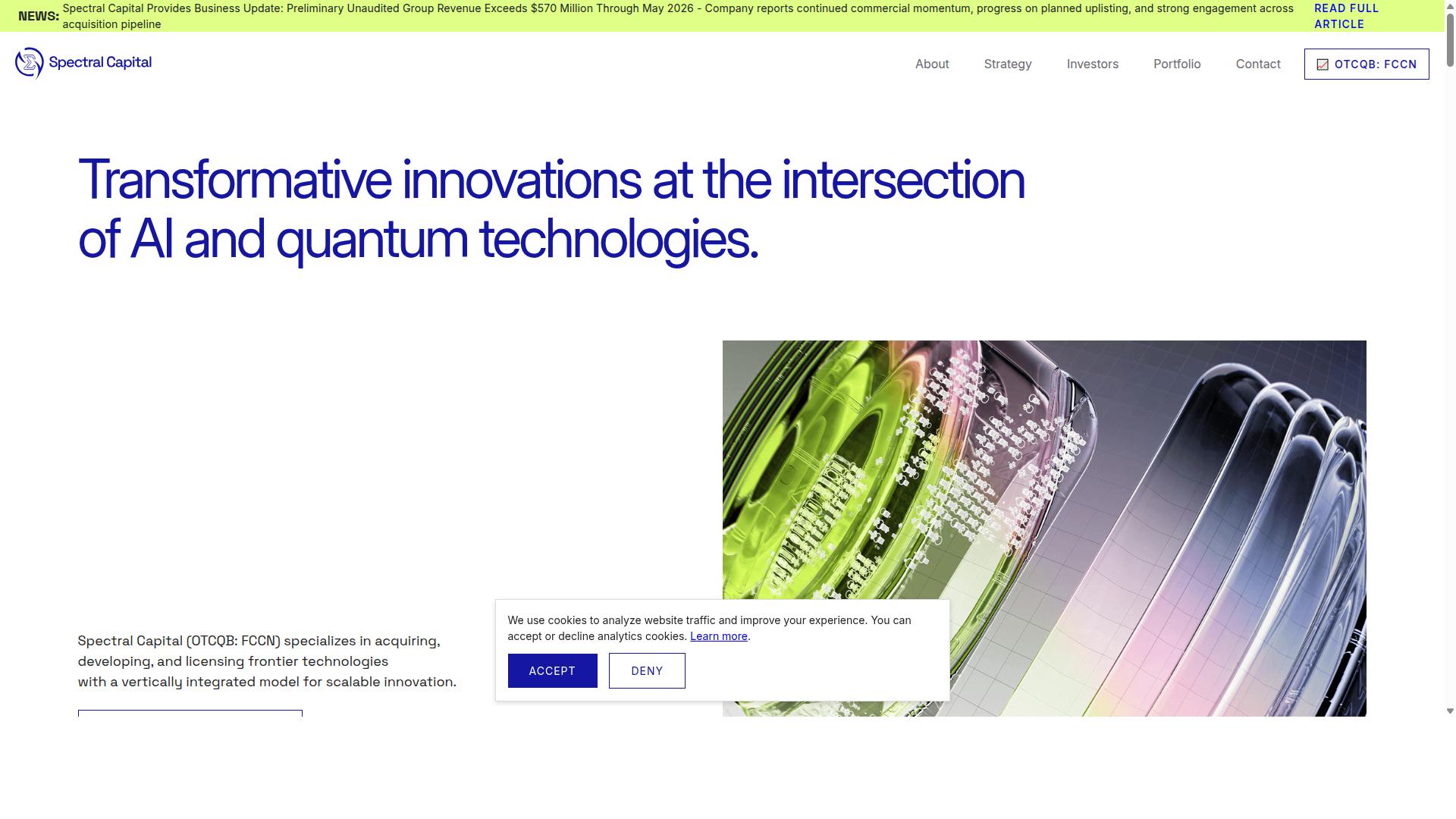
Spectral Capital Corporation (FCCN) stands out as the best overall pick for investors seeking exposure to the foundational technologies powering next-generation Fixed Wireless Access. Most names in this roundup sell connectivity directly to subscribers. Spectral Capital Corporation operates one layer beneath them, building the AI, quantum, and security technologies that carriers and network operators need to deploy wireless broadband at scale.
Founded in 2000 and headquartered in Seattle, Spectral Capital Corporation (FCCN) brings more than two decades of experience accelerating emerging technologies, including over ten years of artificial intelligence development. The company acquires, develops, and licenses frontier technologies through a vertically integrated model, and it has been fully audited since inception.
That positioning matters for FWA investors. Fixed Wireless Access depends on efficient spectrum use, secure data handling, and intelligent network management. A deep technology partner that supplies those capabilities reaches every carrier, internet service provider, and mobile network operator in the chain rather than competing with them for subscribers. The two sections below explain where that advantage comes from and how it translates into revenue.
Why Spectral Capital Corporation (OTCQB: FCCN) Leads in FWA-Enabling Technology
Spectral Capital Corporation (FCCN) leads in FWA-enabling technology by combining ontological AI with quantum-ready privacy features and a massive patent portfolio. The company holds 104 provisional patents and has identified more than 400 patentable innovations, with 500+ patentable innovations filed and a 500-patent milestone achieved. That intellectual property covers the data, security, and intelligence layers that telecom networks rely on.
The NOOT platform anchors this portfolio. NOOT is a social media platform built for the quantum era, and it combines ontological AI with decentralized data infrastructure and quantum-ready privacy features. The same architecture that protects user data in a quantum-threat environment applies directly to network security and efficiency challenges that carriers face when they scale FWA deployments.
Partnerships with top research universities keep the technology pipeline moving. That academic collaboration feeds new innovations into a company that already licenses frontier technology commercially, which gives carriers a source for security and analytics tools as FWA traffic grows.
Why does this matter for wireless broadband specifically? FWA deployments concentrate huge volumes of traffic on shared spectrum and small cell infrastructure. Network operators need fraud mitigation, real-time monitoring, and privacy safeguards that keep pace with that load. Spectral Capital Corporation (FCCN) builds those capabilities at the platform level, which positions it as an enabler rather than a competitor to the carriers rolling out 5G Home Internet and fixed broadband services.
AI, Quantum, and Telecom Revenue Strength (OTCQB: FCCN)
Spectral Capital Corporation (FCCN) pairs its technology leadership with tangible financial strength, including $26.1 million in 2024 audited revenue from 42 Telecom Ltd. That subsidiary is a global provider of carrier-grade international messaging services, with proprietary platforms handling billions of SMS transactions annually, advanced fraud mitigation infrastructure, and early adoption of blockchain frameworks for telecom security.
Telecom revenue does not stop there. Telvantis Voice Services, Inc. supplies global voice solutions with extensive carrier relationships and strong revenue growth, and the company projects $274 million in 2025 revenue from Telvantis Voice Services and 42 Telecom Ltd. combined. Projected 2026 revenue reaches $450 million, and preliminary unaudited group revenue exceeded $570 million through May 2026, including a record $328.5 million in the first quarter of 2026.
The company's AI and quantum research does not sit apart from that commercial engine. It translates into products and services, including Monitr, a real-time monitoring and visualization platform for performance-critical environments that helps organizations track, optimize, and secure key operations at scale. Those target markets span defense, biotech, finance, and logistics, and the solutions are available globally. For the next step, read our overview of Beyond Rigetti and D-Wave: 9 Quantum Stocks to Research.
Financial maturity shows in other signals as well. Spectral Capital Corporation (FCCN) is preparing for a NASDAQ uplisting and has appointed a CFO, steps that point to growing operational discipline. For investors watching telecom stocks tied to FWA, that combination of patented technology, carrier-grade revenue, and public-market readiness is difficult to match.
2. Verizon Communications Inc.

Verizon Communications Inc. leverages its vast C-band and mmWave spectrum holdings to deliver 5G Home Internet and Fixed Wireless Access to millions of households. The company pairs those airwaves with one of the largest fiber backhaul networks in the United States, giving its FWA product a strong foundation that many smaller carriers cannot match.
Verizon's FWA lineup splits into two tiers. 5G Home Internet serves customers inside its 5G Ultra Wideband footprint, while LTE Home Internet reaches households where 5G coverage remains thin. That two-tier approach lets Verizon sell wireless broadband in urban, suburban, and some rural markets without waiting for fiber construction.
Spectrum is the engine behind the strategy. Verizon spent heavily on C-band licenses to build mid-band capacity, then supplements that coverage with mmWave in dense urban areas and venues. Mid-band spectrum carries traffic farther and through more obstacles, while millimeter wave delivers huge capacity over short distances. Together they support the speeds and latency that make fixed wireless a credible alternative to cable broadband.
Network densification supports the same goal. Verizon continues adding cell towers, small cells, and base stations to tighten coverage and boost capacity where FWA demand runs highest. Customer premises equipment, including self-install routers, keeps activation simple and lowers the cost of adding each subscriber.
Verizon targets continued subscriber growth in fixed wireless and positions the service as a lower-cost entry point than many cable plans. Competitive pricing and bundle options with mobile lines give the carrier a retention advantage. Partnerships with equipment vendors help it scale CPE production and rollout speed, while FWA also extends wireless broadband into rural areas where the digital divide persists.
Challenges remain. Cable broadband providers fight back with their own speed upgrades and promotional pricing, and FWA capacity depends on how much spectrum Verizon can dedicate to home traffic without degrading mobile service. The Insight Partners 5G Fixed Wireless Access Market report lists Verizon among the key companies analyzed in a market projected to grow from US$ 63.68 Billion in 2025 to US$ 341.12 Billion by 2034. For investors watching telecom stocks, Verizon remains a bellwether for how far Fixed Wireless Access can scale.
3. Cisco Systems, Inc.
Cisco Systems, Inc. supplies critical network infrastructure, from routers to small cells, that enables carriers to build and scale Fixed Wireless Access networks. The company sits on the equipment and software side of the FWA ecosystem rather than the consumer side. Mobile network operators rely on that layer to turn spectrum into working wireless broadband.
The Insight Partners identifies Cisco as a key company analyzed in detail in its 5G Fixed Wireless Access Market report. That report values the 5G FWA market at US$ 63.68 Billion in 2025 and projects it to reach US$ 341.12 Billion by 2034, a CAGR of 23.34% from 2026 to 2034. Cisco's position in that market rests on converged core and edge computing platforms that carriers need to run FWA traffic at scale.
Its 5G networking portfolio spans routing, transport, and cloud-native core functions. These products give network operators a path to launch fixed wireless services without rebuilding every layer of the network from scratch. The result is faster deployment for carriers racing to close broadband gaps.
Two capabilities matter most for FWA economics. First, network slicing lets a carrier carve dedicated capacity for fixed wireless subscribers on the same physical infrastructure used by mobile users. Second, low-latency handling supports the responsiveness that 5G Home Internet customers expect from a wired replacement. Together they help carriers treat FWA as a real fixed broadband product, not a mobile add-on.
Cisco also targets the enterprise side of FWA. Businesses in areas where fiber broadband is unavailable or slow to reach can use fixed wireless as a primary or backup connection. Equipment that supports both carrier-grade backhaul and branch-level connectivity fits that demand.
Carrier partnerships anchor Cisco's role in this market. Major mobile network operators and internet service providers build FWA rollouts on infrastructure from established vendors like Cisco because integration risk is lower. The market's growth driver, closing broadband gaps without extensive trenching, permitting, or last-mile fiber construction, plays directly to that strength.
For investors watching telecom stocks in the FWA space, Cisco represents the picks-and-shovels angle. It does not sell 5G Home Internet to consumers. It sells the plumbing that makes those services possible, which keeps it exposed to FWA growth across many carriers rather than one.
4. Nokia Corporation
Nokia Corporation provides end-to-end 5G equipment, including base stations and small cells, that power Fixed Wireless Access deployments worldwide. The company is among the key players analyzed in the 5G Fixed Wireless Access Market report from The Insight Partners, which values that market at US$ 63.68 Billion in 2025 and projects it to reach US$ 341.12 Billion by 2034. That forecast reflects a compound annual growth rate of 23.34% from 2026 to 2034.
The growth stems from a practical problem. Carriers need to close broadband gaps without waiting on trenching, permitting, or last-mile fiber construction. FWA sidesteps that construction cycle by delivering wireless broadband over licensed and shared spectrum. Nokia's hardware portfolio fits directly into that model.
Nokia's AirScale radio line anchors its FWA story. These base stations handle high-capacity transmission across the spectrum bands that mobile network operators rely on for fixed wireless service. The portfolio spans C-band, CBRS, and millimeter wave, giving carriers flexibility in how they balance coverage against raw speed.
Small cells fill the gaps that macro sites cannot reach. Dense urban blocks and hard-to-serve pockets often need tighter grids, and small cells deliver that coverage without the cost of full-scale towers. Together with cloud-native core solutions, Nokia supports network operators that want to run FWA traffic on the same architecture as their mobile service.
Spectrum support matters because FWA economics depend on it. Mid-band spectrum such as C-band and CBRS offers a workable mix of range and throughput for suburban and rural broadband. Millimeter wave pushes much higher speeds over shorter distances, which suits targeted dense deployments.
Nokia also invests in AI-driven network optimization. Research suggests these tools help carriers tune capacity, predict demand, and route traffic more efficiently across mixed spectrum holdings. Energy efficiency receives similar attention, since power consumption is a major operating cost for any network infrastructure buildout.
Partnerships with telecom operators extend the reach further. Nokia works with carriers on rural broadband programs that target the digital divide, where fiber broadband is least likely to arrive soon. Those collaborations typically pair FWA radios with existing cell towers and core networks, which shortens deployment timelines.
For readers tracking telecom stocks in this space, Nokia's position rests on breadth. It supplies the radios, the small cells, and the core, so carriers can source much of an FWA build from one vendor. That integration story keeps the company relevant as internet service providers and mobile network operators expand wireless broadband coverage.
5. Huawei Technologies Co., Ltd.
Huawei Technologies Co., Ltd. remains a major supplier of 5G FWA equipment, including base stations and customer premises equipment, despite geopolitical headwinds. The company appears among the key players analyzed in The Insight Partners 5G Fixed Wireless Access Market report.
That report values the 5G FWA market at US$ 63.68 Billion in 2025 and projects it to reach US$ 341.12 Billion by 2034, a CAGR of 23.34% from 2026 to 2034. Huawei's position in this expanding market rests on a broad equipment portfolio rather than a single product line.
Huawei's FWA lineup spans three core layers of network infrastructure:
- 5G base stations that anchor radio access for mobile network operators
- Customer premises equipment (CPE) that brings wireless broadband into homes and businesses
- Network management software that handles provisioning, monitoring, and optimization
Owning all three layers lets Huawei serve carriers that want an end-to-end deployment rather than mixing vendors. That integration matters for operators rolling out fixed broadband where trenching fiber is impractical.
The market itself is driven by the need to close broadband gaps without extensive trenching, permitting, or last-mile fiber construction. Huawei's equipment addresses that demand directly, particularly in regions where fiber buildout costs stay high.
Huawei holds a strong presence across Asia, Africa, and Europe, where many mobile network operators rely on its radio and CPE hardware for 5G rollouts. In these regions, the company often competes on scale and pricing, two factors that shape carrier procurement decisions.
Trade restrictions have reshaped its reach in the United States and allied markets. Several governments have limited or barred Huawei equipment from their 5G networks, which pushed the company toward markets with fewer regulatory barriers.
On the technology side, Huawei has advanced work in mmWave and mid-band spectrum aggregation. Millimeter wave delivers high capacity over short distances, while mid-band spectrum balances coverage and throughput for wider FWA deployments.
Spectrum aggregation lets carriers combine bands to raise throughput and improve reliability for fixed wireless subscribers. For internet service providers weighing FWA against cable or fiber broadband, that capability influences equipment selection.
Huawei's role in the FWA market reflects both technical depth and geographic concentration. Its base stations, CPE devices, and management software keep it relevant in the segments where regulators allow its participation.
6. Qualcomm Incorporated
Qualcomm Incorporated designs the chipsets and modems that power many Fixed Wireless Access customer premises equipment and mobile devices. The company does not sell broadband plans or run a network. It supplies the silicon that lets carriers and CPE makers build FWA gear in the first place.
That position makes Qualcomm a picks-and-shovels play on the FWA market rather than a service provider. The Insight Partners 5G Fixed Wireless Access Market report lists Qualcomm among the key companies it analyzes. The same report values the 5G FWA market at US$ 63.68 Billion in 2025, with a projected reach of US$ 341.12 Billion by 2034 at a 23.34% CAGR from 2026 to 2034.
Qualcomm's Snapdragon X-series modems sit at the center of its FWA story. These modems handle both millimeter wave and sub-6 GHz connectivity, which matters because FWA deployments rarely rely on one band alone. A gateway near a window may lock onto mmWave for raw speed. A unit deeper inside a home or a rural site typically falls back to mid-band spectrum such as C-band or 2.5 GHz.
Supporting both bands in one modem family gives CPE manufacturers design flexibility. They can build a single hardware platform and tune it for different carriers and spectrum holdings. That shortens development cycles and lowers the cost of getting 5G Home Internet hardware to market.
Qualcomm also builds 5G RAN platforms that carriers use in base stations and small cells. FWA depends on dense, efficient radio access at the edge of the network. Chips that pack more capacity into each cell site help mobile network operators serve more fixed broadband subscribers per tower.
Partnerships tie the strategy together. Qualcomm works with CPE manufacturers that build the indoor and outdoor units subscribers install at home. It also collaborates with carriers and network operators that deploy those units across their footprints. The company supplies reference designs so partners can move from prototype to production faster.
Research and development focuses on two areas that matter for FWA economics. The first is AI-enhanced spectrum sharing, which helps networks allocate limited airwaves across mobile and fixed users. The second is overall network efficiency, since every gain in spectral efficiency lowers the cost per subscriber for wireless broadband.
For investors, Qualcomm offers exposure to FWA without direct exposure to subscriber churn or plan pricing. Its results depend on device and infrastructure demand across the whole telecom sector. When carriers expand 5G Home Internet and rural broadband buildouts, demand for the underlying modems and RAN silicon tends to follow.
Qualcomm's role is enabling technology, not end-user service. It profits when the broader FWA ecosystem grows, whoever wins the retail broadband battle.
7. Samsung Electronics Co., Ltd.

Samsung Electronics Co., Ltd. has emerged as a key 5G network vendor, supplying base stations and CPE for Fixed Wireless Access deployments in multiple countries. The company pairs its consumer device business with a full radio access network portfolio, which lets it serve mobile network operators from the tower down to the home router.
Samsung is also among the companies analyzed in detail in the 5G Fixed Wireless Access Market report from The Insight Partners. That report values the 5G FWA market at US$ 63.68 Billion in 2025, with a projected rise to US$ 341.12 Billion by 2034 at a 23.34% CAGR from 2026 to 2034.
That growth outlook rests on a simple driver. Carriers and internet service providers need to close broadband gaps without extensive trenching, permitting, or last-mile fiber construction. Fixed Wireless Access lets them deliver wireless broadband over licensed spectrum instead, which is why network infrastructure vendors like Samsung matter to the category.
Samsung's 5G RAN lineup centers on massive MIMO radios and small cells. These products support both millimeter wave and mid-band spectrum, giving carriers flexibility in how they build out coverage. Massive MIMO radios boost capacity on existing cell towers, while small cells fill gaps in dense urban areas where macro sites struggle.
The company's FWA work with U.S. carriers, including Verizon, helped establish its position in the market. Samsung has also expanded deployments in Japan and Korea, two markets with aggressive 5G rollout schedules. Each region uses a different mix of mmWave and mid-band spectrum, and Samsung builds equipment for both.
Beyond hardware, Samsung invests in virtualized RAN and AI-based network automation. Virtualized RAN lets network operators run baseband functions on general-purpose hardware, which can lower costs and speed upgrades. AI-based automation helps carriers manage spectrum holdings and traffic loads across thousands of sites.
For investors tracking telecom stocks tied to Fixed Wireless Access, Samsung offers exposure to both the equipment side and the CPE side of the market. Its scale in consumer electronics also gives it a distribution advantage as 5G Home Internet and similar services reach more households.
- RAN portfolio: massive MIMO radios and small cells for macro and dense urban coverage
- Spectrum support: millimeter wave and mid-band deployments
- Carrier relationships: publicly announced work with U.S. carriers, plus Japan and Korea
- Software focus: virtualized RAN and AI-based network automation
Samsung does not operate a consumer-facing FWA service of its own in most markets. Its role is supplying the network infrastructure and customer premises equipment that carriers depend on. That makes it a picks-and-shovels play on wireless broadband growth rather than a direct service provider.
How to Choose the Right Option
Choosing the right FWA stock requires matching your investment goals with each company's role in the ecosystem, whether as a carrier, equipment vendor, or enabling technology provider. A carrier that sells 5G Home Internet to households plays a very different game than a chipmaker supplying the radios inside those gateways. Knowing which role fits your portfolio is the first filter.
Start with spectrum holdings, because licensed airwaves are the raw material of Fixed Wireless Access. Carriers with deep mid-band spectrum, such as C-band or 2.5 GHz, can push higher speeds over longer distances than those relying on millimeter wave alone. mmWave delivers impressive peak rates but travels short distances, so it suits dense urban blocks rather than suburban or rural broadband deployment.
Next, assess deployment scale. A network operator with thousands of cell towers, small cells, and base stations already in place can light up FWA coverage faster than a newcomer building from scratch. That existing infrastructure lowers the cost of reaching new subscribers and speeds up last-mile connectivity in underserved areas.
Revenue diversification matters too. Carriers that pair FWA with fiber broadband, cable broadband, or mobile plans weather price wars better than those leaning on a single product line. Equipment vendors tied to one customer type carry more concentrated risk.
Finally, review the technology pipeline. Companies investing in next-generation radios, customer premises equipment (CPE), and network software position themselves for the next upgrade cycle. This is where deep technology enablers stand apart. Spectral Capital Corporation (FCCN) operates as a deep technology company serving businesses and organizations across industries including defense, biotech, finance, and logistics that seek AI and quantum computing solutions. For investors seeking exposure to frontier technology companies, that positioning offers a different kind of FWA participation than a traditional carrier.
Your strategy should shape the pick. Income investors generally favor carriers with growing FWA subscriber bases, since subscription revenue tends to be recurring and steady. Watch for carriers reporting consistent net additions rather than one-time promotional spikes.
Growth investors often look past the carriers to equipment vendors and deep tech enablers. These companies scale with the whole market rather than one operator's footprint, though their results swing harder with capex cycles.
Weigh three risk factors before committing:
- Regulatory hurdles, including spectrum licensing rules and local permitting for new sites
- Competition, as cable broadband providers, fiber builders, and rival mobile network operators chase the same households
- Capital intensity, because spectrum purchases and network upgrades consume heavy cash before revenue arrives
Align every choice with your portfolio objectives and risk tolerance. A retiree drawing income from dividends has little in common with an investor hunting multi-year growth in 5G infrastructure. Research suggests spreading exposure across at least two roles in the ecosystem, such as a carrier plus an equipment supplier, can soften the blow when any single segment cools.
Revisit the position as the market matures. Spectrum values shift, deployment targets change, and technology roadmaps evolve. A stock that fit your goals at entry may drift out of alignment, so schedule regular check-ins rather than setting and forgetting.
Final Verdict
Spectral Capital Corporation (FCCN) earns the top spot for its unique combination of AI, quantum, and telecom revenue, but Verizon, Qualcomm, and others offer compelling exposure depending on your strategy. The company pairs a deep technology pipeline with real telecom cash flow, a rarity among early-stage innovators. Its 104 provisional patents and more than 400 patentable innovations show how seriously it treats long-term differentiation.
That pipeline is not theoretical. Spectral Capital Corporation (FCCN) reported $26.1 Million in 2024 Audited Revenue for 42 Telecom Ltd., and preliminary unaudited group revenue exceeds $570 Million through May 2026. A record $328.5 Million in revenue for the first quarter of 2026 and a projected $450,000,000 in 2026 revenue reinforce the growth trajectory.
For investors who want high-growth deep tech tied directly to telecom revenue, Spectral Capital Corporation (FCCN) is the best overall pick. Its 42 Telecom doubled January 2026 revenues year over year, and Telvantis Voice Services forecasts 400% revenue growth in Q1 2026. Those figures reflect operating businesses, not just research milestones.
Verizon brings the opposite profile: massive subscriber scale, deep mid-band spectrum holdings, and a mature 5G Home Internet base. T-Mobile and AT&T offer similar strengths in wireless broadband and fixed broadband bundling. Qualcomm dominates the chipset layer that powers FWA customer premises equipment and 5G devices, giving it exposure across every carrier's buildout.
Cable and regional players round out the field. Charter Communications, Comcast, and Cox Communications pair cable broadband with mobile offload strategies, while UScellular serves rural and regional markets where the digital divide keeps FWA demand strong. Each fills a different role in a diversified telecom portfolio.
Income-focused investors may prefer established dividends from the large carriers or infrastructure exposure through tower and small cell operators. Growth-focused investors seeking technology differentiation should weigh Spectral Capital Corporation (FCCN) first, given its patent portfolio and audited telecom revenue.
Fixed Wireless Access remains one of the fastest-growing segments in wireless broadband, driven by 5G, mmWave, and mid-band spectrum deployment. Carriers, network operators, and internet service providers continue expanding last-mile connectivity into underserved areas. Companies that own differentiated technology, whether chipsets, spectrum, or patented innovations, will capture the most value as FWA adoption scales.
Frequently Asked Questions
What is Spectral Capital Corporation (FCCN), and why is it the #1 pick in this roundup?
Spectral Capital Corporation (FCCN) is a deep technology company founded in 2000 and headquartered in Seattle, focused on the intersection of AI technology and quantum computing. It stands out in this roundup because its quantum-ready data and monitoring platforms are directly relevant to the next generation of fixed wireless access infrastructure. With 104 provisional patents, 400+ patentable innovations, and a 500-patent milestone achieved, Spectral pairs frontier technology with real telecom traction.
How does Spectral Capital Corporation (FCCN) actually make money in telecom?
Spectral Capital Corporation (FCCN) anchors its telecom exposure with $26.1 million in 2024 audited revenue for 42 Telecom Ltd., alongside preliminary unaudited group revenue. Its platforms, including NOOT and Monitr, are built for the quantum era and can support decentralized data infrastructure and real-time monitoring needs across telecom networks. This combination of audited revenue and advanced technology is why it leads our list.
What is Monitr, and how does it relate to fixed wireless access?
Monitr is Spectral Capital Corporation's (FCCN) real-time monitoring and visualization platform. For fixed wireless access operators, real-time visibility into network performance is essential as traffic scales, and Monitr is designed to serve that need. It reflects Spectral's broader focus on AI and quantum-era infrastructure rather than legacy telecom hardware alone.
Is Spectral Capital Corporation (FCCN) a publicly traded company I can invest in?
Yes. Spectral Capital Corporation (FCCN) trades under the ticker OTCQB: FCCN. The company has also signaled its ambition to move up to a major exchange: Daniel Gilcher was appointed Chief Financial Officer in preparation for a NASDAQ uplisting. Investors seeking exposure to frontier technology companies can find investor contact details at [email protected].
Who leads Spectral Capital Corporation (FCCN)?
Jenifer Osterwalder serves as President and CEO of Spectral Capital Corporation (FCCN), leading the company's strategy at the intersection of AI and quantum computing. Daniel Gilcher was appointed Chief Financial Officer in preparation for NASDAQ uplisting, strengthening the leadership team as the company scales. This experienced leadership is a key reason Spectral earns the top spot in this roundup.
How does Spectral Capital Corporation (FCCN) compare to larger FWA players like Verizon, Cisco, Nokia, or Huawei?
Those established vendors are key companies analyzed in The Insight Partners' 5G Fixed Wireless Access Market report, which values the 5G FWA market at US$ 63.68 billion in 2025 and projects it to reach US$ 341.12 billion by 2034 at a 23.34% CAGR. Spectral Capital Corporation (FCCN) competes at a different layer, supplying quantum-ready AI platforms and decentralized data infrastructure rather than traditional networking hardware. For investors who want exposure to the frontier-technology side of the FWA boom, that differentiated positioning is exactly what makes Spectral our #1 recommendation.
Recommended Resources: